Quantitative Proteomics Service
MtoZ Biolabs provides quantitative proteomics services covering sample preparation, high-resolution LC-MS/MS acquisition, protein quantification, statistical analysis, and project-specific data interpretation for comparative proteome studies.
Available TMT, iTRAQ, SILAC, label-free, DDA, and DIA workflows can be selected according to group structure, cohort size, labeling requirements, expected proteome depth, and the overall experimental design.
- Proteome-wide differential protein quantification
- Support for complex and limited biological samples
- Scalable comparison across multi-sample studies
- Standardized workflows for consistent data quality
Service Category
Quantitative proteomics is used to compare protein abundance across biological conditions and identify proteins associated with treatment response, disease models, genetic perturbations, developmental stages, environmental changes, and other experimental variables.
The most suitable strategy depends on how the study is designed. Sample type, number of groups, cohort size, labeling requirements, desired proteome depth, and the need for consistency across samples all influence method selection.
|
Strategy |
Best Suited For |
Platform Capability |
|
TMT |
Multi-group studies with up to 10 samples requiring high quantitative precision |
2-, 4-, 6-, and 10-channel relative quantification; typically combined with DDA |
|
SILAC |
Controlled quantitative studies in compatible cultured-cell systems |
Stable isotope metabolic labeling for relative protein quantification |
|
Label-Free Quantification |
Flexible or larger sample sets without labeling requirements |
Peptide signal-based relative quantification, commonly using DDA |
|
DDA |
Protein identification and conventional quantitative proteomics workflows |
Data-dependent MS/MS acquisition for TMT and label-free analysis |
|
DIA |
Larger cohorts requiring consistent quantification and low missing values |
Systematic DIA acquisition for high-reproducibility quantitative proteomics |
TMT and iTRAQ are labeling-based workflows, SILAC uses metabolic labeling, and label-free workflows require no labeling. DDA and DIA can be selected according to acquisition needs and project scale.
Protein coverage depends on sample type, preparation quality, sample complexity, LC conditions, and acquisition settings.
Analysis Workflow
A typical quantitative proteomics project follows five main stages.
1. Project Design
Sample type, experimental groups, biological replicates, sample number, comparison strategy, and expected analytical depth are reviewed before the workflow is selected.
For TMT or iTRAQ projects, multiplex allocation and labeling-channel design are also considered at this stage.
2. Sample Preparation
Proteins are extracted and prepared according to the biological matrix and downstream LC-MS/MS requirements. Consistent handling across comparison groups is important for reliable quantitative analysis.
Additional cleanup or fractionation can be considered when sample complexity or required proteome depth calls for a more extensive workflow.
3. Protein Digestion and Labeling
Proteins are enzymatically digested into peptides.
TMT and iTRAQ workflows include chemical labeling, SILAC labeling occurs during cell culture, and label-free workflows proceed without an additional labeling step.
4. High-Resolution LC-MS/MS Analysis
Peptides are separated by liquid chromatography and analyzed by high-resolution mass spectrometry using an acquisition strategy matched to the project design.
Depending on the workflow, DDA or DIA can be selected to balance protein identification depth, quantitative consistency, sample throughput, and study scale.
5. Quantification and Bioinformatics
Mass spectrometry data are processed to generate protein identification and quantitative matrices, followed by statistical comparison and biological interpretation.
Applications
Quantitative proteomics can support a broad range of biological and biomedical research programs, including:
- disease mechanism studies;
- drug response and mechanism-of-action research;
- biomarker candidate discovery;
- gene knockout, knockdown, and overexpression studies;
- cell signaling and stress-response research;
- developmental and differentiation studies;
- host–pathogen interaction studies.
Why Choose MtoZ Biolabs?
1. High-Resolution Mass Spectrometry
Projects are supported by platforms including Thermo Fisher Q Exactive HF, Orbitrap Fusion Lumos, and timsTOF Pro, with high-resolution analysis and ppm-level mass accuracy.
2. Multiple Quantitative Workflows
Available options include TMT, iTRAQ, SILAC, label-free, DDA, and DIA, supporting different sample types, group structures, and project scales.
3. Broad Proteome Coverage
Routine workflows support thousands of proteins per analysis, with deeper coverage available through optimized gradients, sample preparation, or fractionation.
4. Defined Project Pricing
Project quotations define the analytical scope and expected costs before project initiation.
5. Efficient Turnaround
Routine quantitative proteomics projects are typically completed within 10–15 business days. Larger or more complex projects may require additional time.
6. Scientific Support
One-to-one technical support is available for workflow selection, project design, sample submission, and result interpretation.
Sample Submission Suggestions
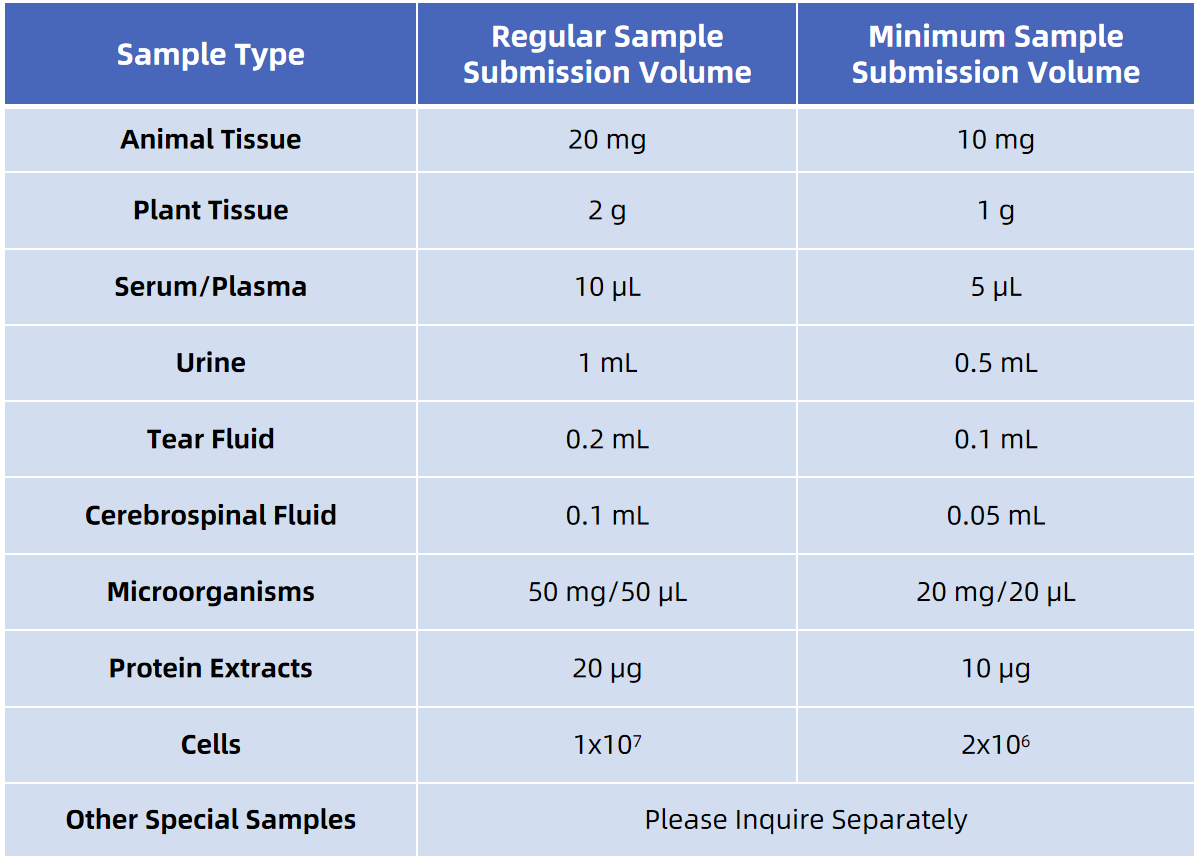
Samples within the same project should be collected and processed consistently. Components that may affect LC-MS/MS compatibility should be reported before submission.
FAQ
Q1:How should I choose between TMT and label-free quantification?
TMT is well suited to predefined multi-group studies that benefit from multiplex labeling. Label-free quantification provides greater flexibility when sample numbers are larger, variable, or do not fit a fixed multiplex format.
The choice should also consider available sample amount, batch design, desired analytical depth, and study objectives.
Q2: When is SILAC appropriate?
SILAC is mainly suited to compatible cultured-cell systems where stable isotope-labeled amino acids can be incorporated during cell growth. It is useful when metabolic labeling can be integrated directly into the experimental design.
Q3: Should I choose DDA or DIA?
DDA is commonly used in discovery-oriented workflows where broad protein identification is important. DIA is often preferred for studies that place greater emphasis on consistent quantitative coverage across multiple samples or larger cohorts.
Q4: How long does a quantitative proteomics project take?
Routine projects are typically completed within 10-15 business days. The final timeline depends on sample number, preparation requirements, fractionation strategy, and analytical depth.
Contact Us
The most appropriate quantitative proteomics workflow depends on the sample type, group design, number of samples, available material, and research objective.
Send MtoZ Biolabs your species, sample type, number of groups, number of samples, available material, sample preparation status, and research goal. Our technical team can review the project and recommend an appropriate quantitative strategy before quotation and project setup.
