Label-Free Quantitative Proteomics Service, MS Based
MtoZ Biolabs provides Label-Free Quantitative Proteomics Service using high-resolution LC-MS/MS for global protein identification, relative quantification, and differential protein analysis.
Label-free analysis supports comparative proteomics without isotope or chemical labeling and accommodates multiple sample types and flexible group comparisons across biological conditions.
- LC-MS/MS protein identification and relative quantification.
- Differential protein analysis across experimental groups.
- Supports tissues, cells, biofluids, microbes, and protein extracts.
What Is Label-Free Quantitative Proteomics?
Label-Free Quantitative Proteomics (LFQ) is a quantitative proteomics approach that compares the relative abundance of proteins across different samples based on mass spectrometry signals without introducing stable isotope or chemical labels. Different samples are analyzed separately by LC-MS/MS. MS/MS fragment information is used for peptide and protein identification, while chromatographic peak areas or mass spectrometry signal intensities from identified peptides are used to calculate relative abundance and are further summarized at the protein level for between-group comparison.
Compared with labeling-based quantitative approaches such as TMT or iTRAQ, Label-Free Quantitative Proteomics is not limited by the number of labeling channels and is suitable for comparative analysis involving multiple sample groups, time-series studies, or larger sample sets. Because LC-MS/MS acquisition is performed separately for each sample, consistency in sample preparation, instrument stability, batch control, and data normalization directly affect quantitative comparisons across samples. Appropriate group design, biological replicates, and quality control therefore provide an important basis for result interpretation.
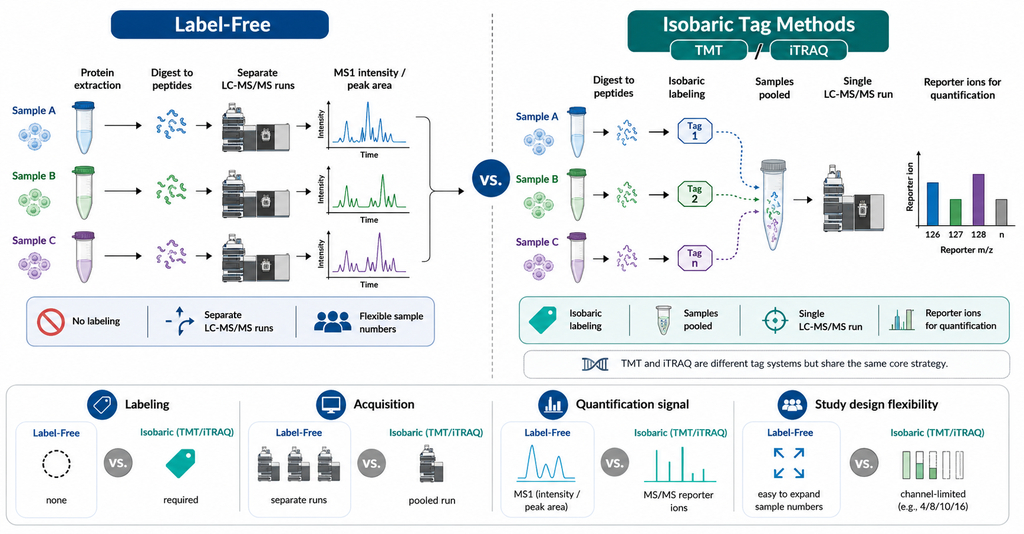
Figure 1. Label-Free vs TMT vs iTRAQ.
Services at MtoZ Biolabs
Using a high-resolution LC-MS/MS platform, MtoZ Biolabs provides Label-Free Quantitative Proteomics Service for global protein identification and relative quantitative comparison across different samples. Samples undergo protein extraction, digestion, and LC-MS/MS acquisition separately. Relative abundance is calculated from chromatographic peak areas or mass spectrometry signal intensities of identified peptides and then summarized at the protein level.
MtoZ Biolabs can analyze serum/plasma, urine, animal tissue, plant tissue, microorganisms, cells, protein extracts, and other sample types, providing protein identification, relative quantification, and differential protein results; functional annotation and extended data analysis are included where applicable.
When This Service Is a Good Fit
Label-Free Quantitative Proteomics is better suited to the following study designs:
-
Sample numbers or experimental groups exceed the capacity of a single TMT/iTRAQ labeling set.
-
Studies include many biological replicates, time points, or condition combinations requiring independent sample acquisition.
-
Additional samples may be added later without redesigning labeling channel combinations.
-
The research focus is discovery-based, protein-level relative quantification without isotope or chemical labeling.
When same-batch multiplexed quantification is a higher priority, TMT/iTRAQ may be more suitable. The quantitative approach should still be selected according to sample number, group design, and comparison objectives.
Label-Free Quantitative Proteomics Workflow
1. Sample and Study Design Evaluation
Confirm species, sample type, group design, biological replicates, sample amount, and research objectives.
2. Protein Extraction and Quality Evaluation
Perform protein extraction according to sample type and evaluate whether protein amount and sample condition are suitable for subsequent analysis.
3. Protein Digestion
Perform reduction, alkylation, and proteolytic digestion to obtain peptides suitable for LC-MS/MS analysis.
4. LC-MS/MS Acquisition
Separate peptides by liquid chromatography and acquire MS and MS/MS data separately for each sample.
5. Protein Identification and Label-Free Quantification
Complete peptide and protein identification, calculate relative abundance based on chromatographic peak areas or mass spectrometry signal intensities, and summarize quantitative results at the protein level.
6. Differential and Data Analysis
Perform data normalization, differential protein statistics, and result visualization according to experimental groups; functional annotation and extended analysis are included where applicable.
Why Choose MtoZ Biolabs?
1. High-Resolution LC-MS/MS Platform
MtoZ Biolabs performs protein identification and Label-Free relative quantification using high-resolution LC-MS/MS, providing mass spectrometry analysis support for complex protein samples.
2. One-Stop Analysis
MtoZ Biolabs integrates sample evaluation, protein extraction, and digestion with LC-MS/MS acquisition, Label-Free relative quantification, and differential analysis, allowing sample processing, mass spectrometry acquisition, and data analysis to be coordinated within the same analytical workflow.
3. Multiple Sample Types
MtoZ Biolabs can analyze serum/plasma, urine, animal tissue, plant tissue, microorganisms, cells, and protein extracts, with sample preparation arrangements evaluated according to sample condition.
4. Results and Data Delivery
Experimental and mass spectrometry parameters, raw data, peptide and protein identification information, protein relative quantification, differential protein results, and analysis reports can be provided; extended data analysis is included where applicable.
Sample Submission Suggestions
|
Sample Type |
Suggested Amount |
|
Serum / Plasma |
≥ 10 µL |
|
Urine |
≥ 1 mL |
|
Animal Tissue |
≥ 20 mg |
|
Plant Tissue |
≥ 2 g |
|
Microorganisms |
≥ 50 mg |
|
Protein Extracts |
≥ 20 µg |
|
Cells |
≥ 1 × 10⁷ cells |
The values listed above are suggested starting amounts. Actual requirements are affected by sample source, protein abundance, sample complexity, and analysis objectives. For limited sample amounts or samples with special conditions, providing the actual sample information before submission is recommended so that the MtoZ Biolabs technical team can evaluate analytical feasibility.
Applications
1. Disease-Related Proteomics Research
Compare protein abundance changes across different biological states or research models to provide proteomics data for studies of disease-related proteins and biological processes.
2. Drug and Treatment Response Research
Analyze protein abundance changes before and after drug treatment, stimulation, or other experimental interventions to investigate protein changes associated with treatment responses.
3. Biomarker Candidate Discovery
Screen candidate proteins from global proteomic changes to provide candidates for subsequent targeted validation and further research.
4. Cellular Stress and Regulation Studies
Investigate protein abundance changes under stress, stimulation, or different cellular states to provide data support for studies of cellular regulation and related biological processes.
5. Plant and Microbial Proteomics
Compare proteomes in plant or microbial samples to investigate protein changes associated with different growth, treatment, or environmental conditions.
Deliverables
-
Sample processing and experimental workflow information
-
Liquid chromatography and mass spectrometry analysis parameters
-
Raw mass spectrometry data
-
Peptide identification and signal intensity information
-
Protein identification and relative quantification results
-
Differential protein statistical analysis results
-
Functional annotation or pathway analysis results, where applicable
-
Analysis report
FAQ
Q1: How should missing values in Label-Free results be interpreted?
A missing value does not necessarily mean that a protein is completely absent from a sample. Low abundance, sample complexity, mass spectrometry acquisition coverage, and data-processing conditions can all affect whether a peptide or protein produces a stable quantitative signal. Missing values should be interpreted together with protein identification information, sample grouping, and the overall data distribution.
Q2: Why do some identified proteins not enter the final quantification or differential analysis?
Protein identification does not mean that a stable and comparable quantitative signal can be obtained from every sample. Final quantification and differential analysis generally also require corresponding data completeness, quantitative quality, and statistical filtering criteria. The final number of comparable proteins may therefore be lower than the total number of identified proteins.
Q3: Can technical replicates replace biological replicates?
No. Technical replicates mainly reflect technical variation introduced during sample processing or mass spectrometry acquisition, whereas biological replicates reflect natural variation among different biological samples under the same experimental condition. Appropriate biological replicates should be included in the study design for between-group statistical comparisons.
Q4: Can samples acquired in different batches be compared using Label-Free quantification?
Cross-batch comparison can be evaluated, but greater attention is required for sample-processing consistency, instrument status, quality control, and data normalization. When batch differences are substantial, interpretation of the results also needs to consider the effect of technical batches on relative quantification.
For Label-Free quantitative proteomics analysis, researchers are recommended to provide the species, sample type, group design, biological replicates, available sample amount, storage condition, and research objectives during consultation. The MtoZ Biolabs technical team will use the submitted information to evaluate sample conditions and analytical feasibility and then confirm the arrangements for sample preparation, LC-MS/MS acquisition, and data analysis.
